Prince William County Circuit Court serves as the primary trial court for serious legal matters in Prince William County, Virginia. This page explains how Prince William County Circuit Court Case information works, what types of cases appear in the court, and why these records matter. Many visitors arrive here to check case status, review court filings, or confirm hearing schedules. The court manages major legal disputes that require formal trials and judicial rulings. Public case listings help residents, attorneys, journalists, and researchers stay informed about local court activity and official decisions.
The local circuit court holds authority over serious criminal charges, complex civil lawsuits, and appeals from lower courts. For example, felony prosecutions, high-value civil claims, and family law appeals often appear in circuit court records. Each case generates legal records such as filings, orders, hearing dates, and final judgments. Court procedures follow the rules of the Virginia judicial system, which helps maintain consistent legal processes across the state. Reliable court case information helps readers track proceedings, confirm court jurisdiction, and review the role of the court in local judicial administration.
What are Prince William County Circuit Court
Circuit Court Prince William County Virginia serves as the main trial court for serious legal matters within the county. The court handles felony prosecutions, complex civil disputes, and appeals from lower courts within the Virginia state judicial system Prince William County Court as part of the broader judicial structure, operates with authority over both criminal and civil cases. Judges review evidence, hear witness testimony, and issue binding rulings based on Virginia law. The court keeps official case files that include filings, hearing schedules, and final orders. These records support transparency and allow the public to track legal proceedings across Prince William County.
Types of Cases Heard in the Circuit Court
The trial court manages several categories of cases that involve significant legal disputes. Each case type follows formal procedures that align with the Virginia judicial process. Court staff maintain detailed files for every matter filed in the system. These files include complaints, evidence submissions, and written court decisions. Many cases require multiple hearings before a final judgment appears in the court record.
Common case categories include:
- Felony Criminal Cases: Serious criminal charges such as robbery, drug trafficking, or violent offenses. These cases often begin in district court before transfer to circuit court for trial.
- Civil Lawsuits: Disputes involving large financial claims, property matters, or contract disagreements. Civil cases usually involve claims above the district court limit.
- Appeals from Lower Courts: Parties may request a new trial in circuit court after a decision in General District Court or Juvenile and Domestic Relations Court.
Court Hierarchy in the Virginia Judicial System
The Prince William County VA Circuit Court sits in the middle level of the state court structure. It works within a layered system that organizes courts by authority and case type. This structure allows lower courts to manage routine matters, while circuit courts handle trials that require deeper legal review. Cases may move upward through the system when a party files an appeal after a circuit court ruling. Appellate courts review legal decisions to confirm that state law was applied correctly.
| Level of Court | Role in the System |
|---|---|
| Virginia Supreme Court | Highest court in the state; reviews major legal appeals |
| Virginia Court of Appeals | Reviews circuit court decisions in certain cases |
| Circuit Courts | Main trial courts for felony, civil, and appeal cases |
| District Courts | Handle minor criminal offenses, traffic matters, and small civil claims |
How to Search Prince William County Circuit Court Case Records
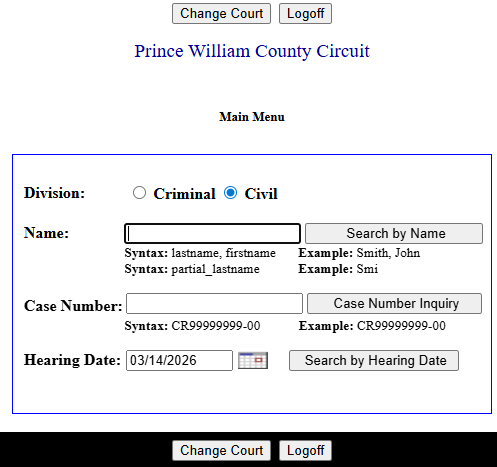
Prince William County Circuit Court Case records can be searched online through the Virginia court database or by visiting the circuit court clerk’s office in person. The system allows users to locate court records Prince William County by case number, party name, or hearing date. Many people search public court records to check case status, review filings, or confirm hearing schedules. The Virginia judicial database stores official case filings, docket entries, and hearing information for many circuit court cases. Basic case details can be viewed online from any computer with internet access. This court database displays case summaries, hearings, and dispositions for many circuit court matters recorded since 1989.
Official search portal: https://eapps.courts.state.va.us/CJISWeb/circuit.jsp
Steps to Guide to the Official Online Case Search
The Virginia Circuit Court Case Information system allows users to perform a docket search through a simple process.
Open the official case search website
- Open your web browser.
- Type or paste this official address into the address bar: https://eapps.courts.state.va.us/CJISWeb/circuit.jsp
- The page will display the Virginia Circuit Court Case Information system.
- This platform connects to the state case management system used by most circuit courts in Virginia.
- Select the correct court
- After the page loads, look for the court selection menu.
- Choose Prince William County Circuit from the list of courts.
- Click Begin to continue to the search page.
Choose the court division
The search page asks for the type of case. Select the division that matches the case you want to locate.
Users usually see two main divisions:
- Criminal Division – felony and criminal circuit court cases
- Civil Division – civil lawsuits, property disputes, contract cases
Choose a search method
The system offers several search options. Each option returns a list of matching cases from the court database.
Users may search by:
- Party Name
- Case Number
- Hearing Date
Review the case results
After entering search details, click Search. Click the case number to open the detailed case page.
The results page shows:
- Case number
- Case status
- Filing date
- Parties involved
- Upcoming hearing dates
How to Read the Case Details Page
Once the case opens, several tabs appear at the top of the page. Common tabs include:
| Tab Name | What It Shows |
|---|---|
| Name List | Returns to the list of search results |
| Pleadings / Orders | Court filings, motions, and legal orders |
| Services | Service status for documents and parties |
Searching Records at the Courthouse
Some records are easier to review in person. Visitors can search files at public computers located in the Prince William County Judicial Center. Most records can be viewed for free at courthouse terminals.
Typical locations include:
- Public Service Center: Room 305
- Criminal Records Section: Room 310
- Civil Records Section: Room 314
Requesting Copies of Case Documents
Copies of official court records Prince William County may require a small fee. Typical costs:
| Document Type | Typical Fee |
|---|---|
| Standard copy | about $0.50 per page |
| Certified court copy | about $2 per document |
| Online document image | about $0.50 per image |
Important Limits on Public Case Searches
Certain records do not appear in the public database. Examples include:
- Juvenile cases
- Adoption files
- Sealed court records
- Confidential filings
Types of Cases Handled in Prince William County Circuit Court
Prince William County Circuit Court hears serious criminal prosecutions, major civil lawsuits, family law matters, and appeals from lower courts. The court functions as the main trial court within the Virginia judicial system for high-level legal disputes. The circuit court holds broad civil and criminal jurisdiction. Cases usually arrive here after preliminary hearings in district courts or through direct civil filings that exceed lower court limits. Judges conduct jury trials, bench trials, and review appeals from district courts. The court clerk maintains official case filings, court orders, and docket records for each matter.
Below are the accurate primary case categories handled in Prince William County Circuit Court:
| Case Type | Description |
|---|---|
| Felony Criminal Cases | Serious criminal prosecutions handled through jury or bench trials |
| Civil Litigation | Lawsuits involving larger financial claims or property disputes |
| Family Law Cases | Domestic legal matters handled by the circuit court |
| Probate & Estate Matters | Administration of wills and estates |
| Appeals from Lower Courts | Review of district court decisions |
Felony Cases
Felony prosecutions form a major part of the criminal docket in Prince William County Circuit Court. A felony is a serious criminal offense that can lead to prison sentences, large fines, or long probation periods. Most felony cases begin in the General district court with an initial hearing. During this stage, the judge reviews evidence to determine if probable cause exists. If the evidence supports the charge, the case transfers to the circuit court for trial.
Common felony offenses heard in the circuit court include:
- Armed robbery
- Drug manufacturing or distribution
- Burglary and property crimes
- Aggravated assault
- Financial fraud involving large amounts
Once the case reaches circuit court, it moves through several criminal trial stages. The prosecution presents evidence to a grand jury. If the grand jury issues an indictment, the court schedules the matter for trial.
Typical felony trial steps include:
- Grand jury indictment
- Arraignment hearing
- Pre-trial motions and discovery
- Jury or bench trial
- Verdict and sentencing
Civil Trials
Civil trials represent another major area handled by Prince William County Circuit Court. These cases involve disputes between private parties, businesses, or organizations. Civil cases appear in circuit court when the financial value of the claim exceeds the limit of district courts. Many lawsuits involve complex legal arguments and extensive documentation. Common civil litigation cases include:
- Contract disputes between businesses
- Property ownership disagreements
- Personal injury lawsuits
- Construction disputes
- Commercial business conflicts
Civil cases start when the plaintiff files a civil complaint with the circuit court clerk. The defendant receives formal notice of the lawsuit through service of process. After filing, the case moves through the civil litigation process:
- Complaint filing
- Defendant response or answer
- Discovery phase with evidence exchange
- Pre-trial motions
- Trial before a jury or judge
- Final judgment
Appeals Court Proceedings
Prince William County Circuit Court plays an important role in the Virginia appellate structure. Many cases reach the circuit court after a party challenges a decision made in a lower court. The circuit court usually conducts a trial de novo, meaning the case is heard again from the beginning. The judge reviews evidence and testimony rather than relying solely on the earlier decision.
Appeals often come from:
- General District Court
- Juvenile and Domestic Relations District Court
Examples of cases commonly appealed include:
- Traffic offense convictions
- Misdemeanor criminal cases
- Civil disputes decided in district court
- Family law rulings
The appellate process typically follows these steps:
- Filing a notice of appeal
- Transfer of the lower court record
- Scheduling of a new hearing or trial
- Review of evidence and testimony
- Final ruling issued by the circuit court judge
Court Structure and Procedures
Prince William County Circuit Court operates with higher court jurisdiction over serious criminal and civil matters within the county. The court exercises broad court authority under the Virginia state judicial system and follows formal trial court procedures for each case type. The Prince William County Circuit Court serves as the main trial court for major disputes that require jury trials, detailed evidence review, and official rulings. This court handles both civil and criminal jurisdiction, which allows judges to oversee felony prosecutions, complex civil lawsuits, family law matters, and appeals from district courts. Each case follows structured procedures designed to keep the legal process organized and consistent across the state judicial system.
Criminal Procedure Steps
Criminal cases in the circuit court usually involve felony charges. These matters follow a structured process that protects the rights of the accused and allows the court to review evidence in a fair setting. Most criminal cases begin in General District Court before moving to the circuit court for trial. Once transferred, the circuit court handles the case through several stages.
Typical criminal procedure steps include:
- Grand Jury Indictment: Prosecutors present evidence to a grand jury. The grand jury decides whether the case should proceed with formal charges.
- Arraignment Hearing: The accused person appears before the circuit court judge. The judge reads the charges and schedules future hearings.
- Pre-Trial Motions: Attorneys file legal motions regarding evidence, witnesses, or procedural issues.
- Trial Proceedings: A jury or judge reviews testimony, evidence, and legal arguments presented by both sides.
- Verdict and Sentencing: If the defendant is found guilty, the court determines the appropriate penalty under Virginia law.
Civil Procedure Steps
Civil cases involve disputes between parties seeking financial compensation or court orders regarding property or contracts. These cases fall under the civil jurisdiction of the circuit court. Civil litigation often begins when one party files a formal complaint with the circuit court clerk. The complaint describes the dispute and requests relief from the court.
Typical civil procedure steps include:
- Complaint Filing: The plaintiff files a legal claim that begins the lawsuit.
- Service of Process:The defendant receives official notice of the lawsuit and instructions to respond.
- Discovery Phase: Both parties exchange documents, evidence, and witness information.
- Pre-Trial Hearings: Attorneys ask the judge to resolve legal issues before trial.
- Trial or Settlement: The dispute may resolve through settlement discussions or proceed to a jury or bench trial.
- Final Judgment: The court issues a written ruling that determines liability, damages, or legal rights.
What are Circuit Court Case Records
A Prince William County Circuit Court Case record shows the timeline of a legal matter, including filings, hearings, rulings, and the final judgment. The court docket acts as a chronological list that tracks every action taken in the case. Court records created in Prince William County Circuit Court provide detailed information about criminal trials, civil litigation, and appeal proceedings. These records appear in the court database and in official case files maintained by the clerk’s office. Each entry within the court docket shows what happened during the life of the case, from the first filing to the final ruling. Readers who review these records can follow the progress of a case step by step. Attorneys, reporters, researchers, and residents often review docket information to confirm hearing schedules, review legal filings, or check case outcomes.
What a Court Docket Shows
A court docket is the official log of activity for a specific case. Every time a document is filed or a hearing occurs, the clerk adds an entry to the docket record. These entries appear in chronological order so readers can see the entire history of the case.
Typical docket entries include:
- Case number unique identifier assigned to the court case
- Party names plaintiff, defendant, or other involved parties
- Filing dates when legal documents were submitted
- Hearing schedules court dates for motions or trials
- Court rulings decisions made by the judge during the case
- Final judgment the official resolution of the dispute
Key Sections in Circuit Court Case Records
Most Prince William County Circuit Court Case files contain several sections that explain what happened in the legal proceeding. Each section helps readers interpret the case timeline and review the actions taken during the proceeding.
| Record Section | Description |
|---|---|
| Case Information | Basic details such as case number, filing date, and court division |
| Party Information | Names of plaintiffs, defendants, attorneys, and involved parties |
| Filings | Legal documents submitted by attorneys or parties |
| Court Orders | Written decisions issued by the judge |
| Hearing Schedule | Dates and times for court appearances |
| Judgment | Final ruling that resolves the case |
Common Filings Found in Court Records
Court filings are written documents submitted during the legal process. These filings form the backbone of the official case record. These documents help explain why certain rulings occurred during the legal process.
Common case filings include:
- Complaint or indictment: document that starts the case
- Motion filings: requests asking the court to make a decision
- Evidence submissions: documents or exhibits presented during trial
- Court orders: written instructions issued by the judge
- Judgment orders: final decision resolving the case
How to Interpret Case Status and Judgments
The final portion of a court record often includes the case disposition, which explains the outcome of the matter. Once a judgment appears in the record, the case usually moves to the closed docket category. The court retains the file for historical and legal reference.
Common outcomes listed in the docket may include:
- Dismissed: the case ended without a trial or judgment
- Guilty / Not Guilty: criminal verdict issued by a jury or judge
- Judgment entered: final civil decision recorded by the court
- Appealed: a party requested review by a higher court
Example Layout of a Court Docket
This chronological format helps readers quickly track the court docket history of a case. Below is a simplified example showing how a docket entry might appear in a Prince William County Circuit Court Case record.
| Date | Docket Entry | Description |
|---|---|---|
| Jan 10, 2024 | Case Filed | Complaint or indictment submitted |
| Feb 5, 2024 | Motion Hearing | Court reviewed pre-trial motions |
| Mar 15, 2024 | Trial Date | Jury trial began |
| Mar 18, 2024 | Verdict Issued | Jury reached decision |
| Apr 2, 2024 | Final Judgment | Court entered official ruling |
Location and Contact Information
Prince William County Circuit Court is located in Manassas, Virginia, and serves as the main courthouse for major civil and criminal trials in the county. Visitors can contact the court through phone, email, or the official website for case information, filings, and record inquiries. The Prince William County Circuit Court courthouse sits in the central judicial area of Manassas. Residents, attorneys, and visitors often come here to file legal documents, review court records, or attend hearings. The clerk’s office manages civil filings, criminal case records, and official court documents. People may contact the court directly for assistance with case status, court schedules, or document requests.
Court Address
Prince William County Circuit Court
9311 Lee Avenue
Manassas, VA 20110
United States
Phone Numbers
Visitors can reach the clerk’s office through the following Prince William County VA Circuit Court phone numbers:
- Main Court Clerk Office: (703) 792-6710
- Civil Case Inquiries: (703) 792-6700
- Criminal Case Inquiries: (703) 792-6700
Email and Website
The official court website provides forms, court service details, and links to online resources related to circuit court cases.
Official Email: circuitcourt@pwcgov.org
Official Court Website: https://www.pwcourts.gov
Office Hours
The courthouse operates during the following court working hours:
| Day | Hours |
|---|---|
| Monday – Friday | 8:30 AM – 4:30 PM |
| Saturday | Closed |
| Sunday | Closed |
Frequently Asked Questions
Prince William County Circuit Court handles serious legal disputes such as felony cases, major civil trials, and appeals court proceedings from lower courts. Many people search common questions to learn how cases move through the circuit court and what records appear in the docket. The circuit court functions as a high-level trial court within the Virginia state judicial system. It oversees criminal prosecutions, civil litigation, probate matters, and appeals from district courts. The questions below explain how these cases work and what users should expect when reviewing circuit court case records.
What types of cases appear in the circuit court?
Prince William County Circuit Court handles several major case categories. The most common include felony criminal trials, civil litigation, family law matters, probate cases, and appeals court proceedings from lower courts. Felony charges such as robbery or major fraud usually move to circuit court after an initial hearing in district court. Civil trials often involve disputes with large financial claims or property issues. The court may conduct jury trials or bench trials depending on the case. Each matter creates official court filings, orders, and judgments stored within the circuit court case record system.
How can someone search a Prince William County Circuit Court Case?
People can locate a Prince William County Circuit Court Case through the Virginia online case information system or by visiting the clerk’s office. Users typically search by case number, party name, or hearing date. Online results usually show the court docket, filing dates, and hearing schedules. The courthouse also provides public record terminals where visitors can review case files. The clerk’s office may help locate case numbers or explain how to request copies of documents. Some confidential records, such as sealed or juvenile cases, may not appear in the public search system.
What happens during a felony criminal trial?
A felony case usually moves through several court stages. Prosecutors present evidence to a grand jury that decides whether to issue an indictment. After the indictment, the defendant appears in court for arraignment and future hearing dates. Attorneys may file motions related to evidence or witness testimony before trial. During the criminal trial, a judge or jury reviews testimony, physical evidence, and legal arguments. The jury or judge then delivers a verdict. If the defendant is found guilty, the court schedules a sentencing hearing where penalties may include prison time, fines, or probation.
How do civil trials work in circuit court?
Civil trials begin when a plaintiff files a legal complaint describing a dispute involving money, contracts, or property rights. The defendant receives formal notice through service of process. Both sides exchange documents and evidence during the discovery stage. Attorneys may ask the judge to resolve legal issues before the trial begins. The case may settle through negotiation, though some disputes continue to trial. During the hearing, witnesses testify and evidence appears before the court. The judge or jury then issues a judgment explaining financial damages or legal responsibilities.
Can a case be appealed after a circuit court decision?
Yes. A party who disagrees with the result of a circuit court trial may continue the appeals court proceedings through higher courts in the Virginia judicial system. The next level usually involves the Court of Appeals of Virginia. The appellate court reviews legal arguments and the trial record to decide whether the circuit court applied the law correctly. Appellate judges may uphold the decision, reverse the ruling, or return the case to the lower court for further proceedings. Appeal cases rely on transcripts, filings, and court rulings recorded during the original trial.