
Prince William County Court Docket is a centralized record of all cases scheduled in the county’s courts. It includes civil, criminal, probate, and family law matters. By consulting the docket, individuals can see the dates, times, and types of hearings set before judges. This makes it easier for attorneys to prepare for cases, for parties to follow legal obligations, and for the public to stay informed about ongoing proceedings. The docket acts as a transparent record of judicial activity, showing not just case listings but also any updates, continuances, or rulings associated with each matter. It also helps maintain accountability within the judicial system by allowing anyone to track how cases progress over time. In addition, the docket serves as an important administrative tool that helps courts organize schedules and manage their daily caseload efficiently.
The court case listings for Prince William County cover the full scope of the local court system, including Circuit Court and District Court matters. These listings are regularly updated to reflect new filings, rescheduled hearings, and case outcomes. Each entry typically includes the names of the parties involved, the case type, the assigned judge, and the hearing date. Access to these records supports accountability in the judicial system and provides a reliable reference for attorneys, parties, and community members who need to monitor court activity. Users can also cross-reference docket records with court orders and judgments to confirm case progress.
What are Court Dockets in Prince William County
A court docket is an official record listing all scheduled hearings, trials, and motions in the county’s courts. It provides a clear overview of upcoming legal proceedings, helping attorneys, parties, and the public track the progress of cases. The docket in the Prince William County Court covers civil, criminal, probate, and family matters, showing dates, courtrooms, and parties involved. Unlike case files, which contain detailed legal documents, the docket focuses on the timing and sequence of court events, making it essential for legal case tracking.
How the Docket Helps Legal Case Tracking
The court docket serves as a reliable tool for tracking the progress of cases. It allows attorneys, litigants, and researchers to monitor upcoming hearings, confirm court dates, and stay aware of any changes in scheduling. By consulting the docket, users can anticipate when motions, trials, or judgments will occur. This overview also supports proper preparation for court sessions and ensures that parties comply with deadlines. The docket provides transparency in the judicial process without requiring access to full case files.
- Tracks upcoming hearings and court dates
- Confirms scheduled motions and trials
- Helps attorneys and parties prepare for court
- Supports monitoring of civil, criminal, probate, and family cases
How to Search the Prince William County Court Docket
To search the Prince William County court docket, users must open the official case-information system provided by the Virginia Judicial System. This portal shows civil and criminal cases from the Prince William County Circuit Court and allows users to find hearings by name, case number, or hearing date.
Open the Official Case Search Portal
Go to the court case information system Official page: https://eapps.courts.state.va.us/CJISWeb/circuit.jsp
- Accept the Disclaimer
- When the site opens, a disclaimer page appears.
- Read the notice about public judicial records.
- Click “Accept” or “Continue” to move forward.
Select the Court
After accepting the disclaimer, a list of courts appears.
- Select Prince William County Circuit Court from the court list.
- Click “Begin” to open the search dashboard.
Open the Case Search Menu
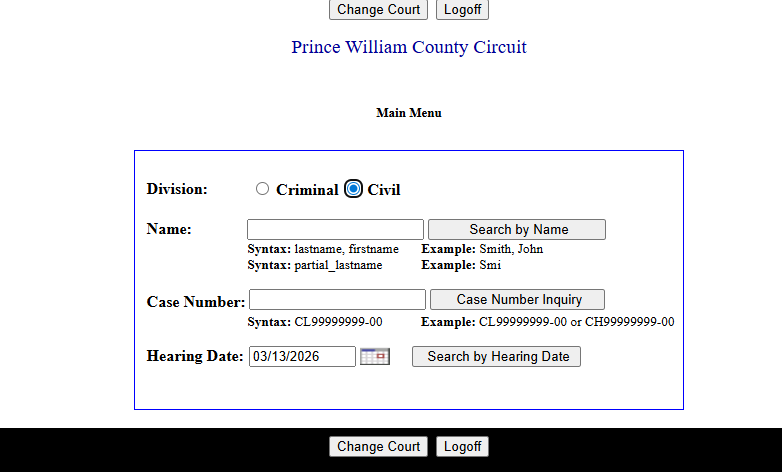
You will now reach the Prince William County Circuit Court Main Menu page. The page contains these search options:
- Division: Criminal or Civil
- Name: Search by party name
- Case Number: Direct case lookup
- Hearing Date: Court docket by date
Choose the Type of Case
Under Division, select the case category:
- Criminal: felony or misdemeanor cases
- Civil: divorce, property disputes, lawsuits, probate matters
Select a Search Method
You can search in three ways:
- Search by Name
- Enter Last Name, First Name
- Example:
Smith, John - Click Search by Name
- Search by Case Number
- Enter the full case number (example:
CL23001234-00) - Click Case Number Inquiry
- Enter the full case number (example:
- Search by Hearing Date: This option displays the daily court docket, showing all cases scheduled for that day.
- Select a date from the calendar
- Click Search by Hearing Date
Review the Results Page
The results page typically displays:
- Case number
- Party names
- Case type
- Courtroom information
- Hearing date and time
- Case status
Why You Need Access to Docket & Case Listings
A court case docket provides a clear record of scheduled hearings, motions, and other court activities. It helps attorneys, residents, and businesses stay informed about the docket schedule and follow legal proceedings taking place in the court system. Access to docket listings from the Prince William County Circuit Court and the broader Virginia Judicial System supports transparency in judicial operations. Court calendars show when a case will be heard, which judge is assigned, and what stage the case has reached. This information helps people prepare for court appearances and monitor legal developments that may affect them.
Stay Updated on Legal Proceedings
The legal proceedings schedule listed in the docket acts as a court timetable for all upcoming hearings. Attorneys and parties involved in litigation rely on this information to manage deadlines, file motions on time, and prepare evidence before a hearing date arrives. Without access to the docket, it becomes difficult to track when a case moves forward or when the court issues new updates.
Benefits for Attorneys, Individuals, and Businesses
Different groups rely on the court timetable and case updates for practical reasons. By reviewing the docket regularly, these users can identify changes like rescheduled hearings, new filings, or case status updates.
- Attorneys: Monitor multiple cases, confirm hearing dates, and plan legal arguments.
- Individuals: Track personal cases such as divorce, property disputes, or criminal matters.
- Businesses: Review litigation schedules, contract disputes, or regulatory cases involving the company.
Monitor Case Progress and Outcomes
Docket records provide a timeline of how a case moves through the court system. They list hearings, motions, continuances, and sometimes the final judgment. The clerk of court maintains and updates these records, making the court case docket a reliable source for checking case progress and reviewing important developments. For journalists, researchers, and community members, docket listings serve as a public reference for court activity. The information shows how legal disputes advance through the judicial process and keeps the public aware of court operations in their local jurisdiction.
What Information is Available in a Court Docket
A court docket Prince William County VA lists the basic information connected to cases scheduled in the local court system. These judicial docket records summarize case activity and show when hearings or motions will occur. Users can quickly review the hearing schedule, identify parties involved, and check the progress of a case. Courts such as the Prince William County Circuit Court within the Virginia Judicial System maintain these entries so attorneys, residents, and researchers can monitor court activity without reviewing full case files.
- Case Number – Unique identification number assigned when the case is filed
- Parties – Names of plaintiffs, defendants, or other involved parties
- Attorney Information – Lawyers representing each party
- Hearing Date and Time – Scheduled appearance before the court
- Judge – The judge assigned to handle the case
- Case Status – Current stage of the legal matter (pending, continued, resolved)
Common Legal Terms Found in Docket Records
Court dockets often contain short legal phrases that describe actions taken during a case. These terms appear in legal record entries to show how the case moves through the court process. By reading these updates, users can understand whether a hearing was postponed, a decision was issued, or a request was filed by attorneys. Reviewing these notes in the docket helps anyone following a case interpret the timeline and progress of the legal proceedings.
- Motion – A formal request asking the court to make a ruling or order
- Continuance – A decision that delays a hearing or trial to a later date
- Verdict – The final decision reached by a judge or jury after trial
- Dismissal – A court order that ends the case before further proceedings take place
Types of Court Case Listings in Prince William County
Court case listings show the range of legal matters scheduled in local courts and help users follow the docket schedule for different case categories. The court case listings maintained by the Prince William County Circuit Court and other courts within the Virginia Judicial System organize hearings into several legal docket types. Each listing appears in the court case registry with a hearing date, case number, and the parties involved. These entries create a structured case calendar that allows attorneys, residents, and businesses to monitor court activity and prepare for upcoming hearings.
Civil Case Listings
Civil case listings involve disputes between private parties, businesses, or organizations. These matters usually focus on financial claims, property issues, or contractual disagreements. The civil docket schedule outlines when motions, hearings, or trials will occur, allowing both sides to prepare legal arguments and documentation before appearing in court. Civil cases often move through several stages, including filing, pre-trial hearings, and final judgment.
- Contract disputes
- Property disagreements
- Personal injury claims
- Business litigation
- Debt collection matters
Criminal Case Listings
Criminal case listings cover offenses prosecuted by the state against an individual accused of violating criminal law. These cases appear in the case calendar with scheduled hearings such as arraignments, preliminary hearings, and trials. The criminal docket schedule helps law enforcement, attorneys, and defendants track the progress of charges as the case moves through the court system.
- Felony charges
- Misdemeanor offenses
- Arraignment hearings
- Trial scheduling
- Sentencing hearings
Family Case Listings
Family court listings include legal matters involving domestic relationships and family responsibilities. These cases appear frequently in the court case registry since they often involve multiple hearings or mediation sessions. The family docket schedule helps participants track proceedings related to divorce, child custody arrangements, and financial support obligations.
- Divorce proceedings
- Child custody hearings
- Child support cases
- Spousal support matters
- Adoption-related hearings
Probate Case Listings
Probate case listings deal with the administration of estates and the legal handling of a person’s property after death. These entries appear in the legal docket types for probate matters and show hearings related to wills, estate disputes, and guardianships. The docket schedule helps executors, beneficiaries, and attorneys follow the legal steps required to manage estate matters through the court.
- Will validation hearings
- Estate administration cases
- Guardianship petitions
- Trust disputes
- Executor appointments
Traffic and Minor Offense Listings
Traffic and minor offense listings appear frequently in local court dockets. These cases often involve violations such as speeding, reckless driving, or other minor legal offenses. The docket schedule shows the hearing date for each citation, allowing defendants to appear in court or resolve the matter according to court instructions. These entries form a large portion of daily court case listings in the county.
- Speeding violations
- Reckless driving charges
- Parking violations
- Minor misdemeanor offenses
- Traffic citation hearings
Fees and Timeline for Accessing Court Dockets
Access to a court docket Prince William County VA usually involves little or no cost for basic case searches. The docket records maintained by the Prince William County Circuit Court within the Virginia Judicial System allow the public to view many court case listings online without a fee. Online searches typically show the case number, parties involved, hearing schedule, and case status. Charges may apply when someone requests printed documents, certified copies, or detailed court records from the clerk’s office. Some third-party websites may also provide access to docket information, but they may charge service or convenience fees. For the most accurate and up-to-date case details, many people rely on the official court website or contact the clerk’s office directly.
Common Court Fees for Docket Records
Courts often allow free viewing of docket entries online. Costs usually apply when someone needs official copies of legal documents. These record access costs help cover the administrative work involved in locating, preparing, and verifying court files.
| Record Type | Typical Fee Type | Description |
|---|---|---|
| Online docket search | Free | Public users can view court case listings and hearing schedules online |
| Printed document copies | Per-page fee | Charged when requesting printed case documents from the clerk |
| Certified court copies | Higher certification fee | Includes official seal and clerk certification for legal use |
| Archived or special record requests | Varies | Additional legal document charges may apply for older or complex files |
Typical Timeline for Receiving Records
The docket processing time depends on how the request is made. Online searches produce results immediately because the information is retrieved directly from the court database. Requests submitted in person or through written applications require review by court staff before records are prepared. This creates a short waiting period in the overall case record timeline.
| Request Method | Estimated Processing Time | Notes |
|---|---|---|
| Online docket search | Immediate | Case listings and hearing schedules appear instantly |
| In-person request at clerk office | Same day or next business day | Depends on clerk workload and number of documents |
| Printed record request | 1–3 business days | Time needed to locate and copy documents |
| Certified copy request | 2–5 business days | Clerk must prepare and authenticate the record |
Planning Ahead for Record Requests
Anyone needing docket records for legal preparation, documentation, or research should request records in advance of deadlines. Busy court periods, holidays, or staffing limitations may extend the processing timeline. Early requests help prevent delays before hearings or filing deadlines. In some situations, expedited service may be available if the request is urgent. Even then, approval depends on clerk availability and court policies. Checking the online docket first allows users to confirm case details before submitting a formal request for copies. This step also helps ensure that the correct case number, party names, and filing information are included in the request. Providing accurate details when contacting the clerk’s office can speed up the processing time and reduce the chances of errors or additional follow-up requests.
Location and Contact Information
The court docket Prince William County VA and other public records are handled at the main judicial complex in Manassas, Virginia. This courthouse provides public court access for civil, criminal, family, probate, and traffic matters. The primary facility used by the Prince William County Circuit Court and other courts in the Virginia Judicial System is located in the Prince William County Judicial Center. Visitors can reach this courthouse for hearings, case filings, and review of docket records or other legal documents.
Address and Directions
The main courthouse complex serving Prince William County is located at:
Prince William County Judicial Center
9311 Lee Avenue
Manassas, VA 20110, United States
This judicial building sits in Old Town Manassas, a central area known for local government offices and historical landmarks. The courthouse complex houses several courts, including circuit, district, and juvenile courts. Nearby landmarks and navigation points include:
- Old Town Manassas historic district
- Grant Avenue intersection
- Manassas government and administrative offices
- Local bus routes serving downtown Manassas
Office Hours and Contact Information
Court offices in the Prince William County Judicial Center operate during standard weekday hours. These hours allow the public to review docket records, file documents, or obtain copies of court materials.
| Service | Information |
|---|---|
| Clerk Office Hours | Monday – Friday, typically 8:30 AM – 5:00 PM |
| General District Court Hours | Monday – Friday, 8:00 AM – 4:00 PM |
| Circuit Court Phone | (703) 792-6015 |
| General District Court Phone | (703) 792-6141 |
| Address | 9311 Lee Avenue, Manassas, VA 20110 |
Frequently Asked Questions
Public users often have questions about how the court case docket system works and how to perform a Prince William County docket search. Court dockets help track hearings, legal filings, and case progress through the local court system. They act as a structured record that shows when a case will appear in court and what actions have been taken. The following answers address common legal docket questions related to case lookups, court schedules, and public record availability through the Virginia Judicial System and the Prince William County Circuit Court.
How do I search a case by name?
A name search is one of the most common ways to locate a court case docket entry. The online search system used by the Virginia courts allows users to enter the last name and first name of a person involved in the case. After submitting the search, the system displays matching results with the case number, parties involved, and scheduled hearings. Users can refine results by selecting civil or criminal divisions. Checking spelling carefully improves accuracy. This method helps attorneys, researchers, and residents quickly find case listings connected to a specific individual. If many results appear, adding a middle initial or narrowing the search by case type may help. This approach saves time compared to manual record searches.
Can I access past court dockets?
Past court dockets are often available through the same Prince William County docket search system used for current cases. When a case has already been heard, the docket may still show the hearing history and case status. Searching by case number or party name can help locate earlier court activity. These listings allow users to review past hearing dates and legal actions taken in the case. Some older records may require additional assistance from the clerk’s office, especially if the file has been archived or moved from the active electronic database. Court staff may need extra time to retrieve these records from storage systems. Reviewing past dockets can help users track how a case progressed through the judicial process.
Are court dockets free to view?
Most online docket searches are available without cost for the public. The Virginia court information system allows users to view basic details from a court case docket, including the case number, hearing schedule, and names of the parties involved. Viewing these case listings online does not usually require payment. Fees normally apply only when someone requests printed records, certified copies, or detailed court documents from the clerk’s office. Free viewing of docket entries helps maintain transparency in the court system and allows the public to monitor legal proceedings. Many users rely on this system to confirm court dates before visiting the courthouse. Online access also reduces the need for in-person record requests.
How often are online dockets updated?
Online dockets are updated regularly throughout the workday as new information is entered into the court database. Court staff record scheduling changes, new filings, and updates to case status as they occur. This means the docket schedule may change several times during a single day. Attorneys and parties often review the docket shortly before their hearing to confirm the time and courtroom assignment. Checking the docket again on the day of a hearing can help avoid confusion if the court calendar has been adjusted or if a hearing has been rescheduled. Updates may appear shortly after a judge issues a scheduling decision. Reviewing the docket frequently helps users stay informed about the most current case information.
Can businesses or researchers use docket searches?
Businesses, journalists, and legal researchers often rely on court case docket searches to review legal activity within a jurisdiction. Companies may monitor cases involving contracts, property disputes, or regulatory issues. Researchers and reporters review docket schedules to track upcoming hearings and verify information about legal proceedings. The public database maintained by the Virginia courts provides a structured record of case listings and hearing timelines. This information helps users follow the progress of cases and gather factual details about court activity without needing full case files. Businesses sometimes review dockets to monitor litigation risks. Researchers may also analyze docket trends to study patterns in court proceedings.