Prince William County Traffic Court manages legal proceedings tied to road safety and driver behavior in Prince William County. Police officers issue citations for traffic violations such as speeding, failure to obey signals, reckless driving, or driving without valid registration. After a citation, the case enters the local court system and receives a hearing date. Judges review evidence, listen to testimony, and decide penalties that may include fines, driving points, or license restrictions. Court records list the charge, hearing schedule, and outcome, which keeps the process transparent for drivers and legal professionals.
Many drivers visit this page after receiving a traffic ticket or court notice. Some want to check hearing dates. Others want details about possible penalties or how traffic case hearings proceed. The information below explains common driving offenses handled by the court, why quick action helps protect driving privileges, and what steps drivers may expect before and during their appearance. Clear details about procedures, court schedules, and citation handling help readers prepare for their upcoming traffic case.
What Is Prince William County Traffic Court?
Traffic court Prince William County VA handles legal cases related to road violations that occur within Prince William County Court it operates as a division of the Prince William County General District Court where judges review citations, hear testimony, and determine penalties. Drivers appear in this court after receiving a citation from law enforcement. The court reviews evidence, hears statements from officers or drivers, and issues decisions based on Virginia traffic law.
Court Jurisdiction in Prince William County
The traffic court Prince William County VA has authority over driving offenses that occur within the boundaries of Prince William County. Law enforcement officers issue citations when drivers violate traffic laws on local roads or highways. The court reviews these citations and decides whether the driver committed the violation. If a case requires a hearing, it receives a scheduled date on the official court docket. This system keeps traffic enforcement organized within the county and helps courts process driving violations efficiently.
Jurisdiction normally includes:
- Traffic violations on county roads
- Incidents on state highways within the county
- Citations issued by local police officers
- Traffic cases involving accidents or unsafe driving
Part of the General District Court System
Traffic cases in the county fall under the authority of the Prince William County General District Court. This court functions as the first level of the Virginia judicial system for many cases. The court processes several legal matters that require quick review and resolution. Traffic hearings appear regularly on the daily docket, where judges review multiple cases in a scheduled session. Court clerks organize filings, manage case records, and maintain the official docket for upcoming hearings.
The General District Court commonly handles:
- Traffic violations and driving offenses
- Minor criminal charges
- Civil cases involving smaller financial claims
- Preliminary hearings for certain criminal matters
Infractions vs Criminal Traffic Offenses
Virginia law separates traffic cases into two main categories: infractions and criminal traffic offenses. This classification determines how the court handles the case and what penalties may apply. Traffic infractions involve minor violations that usually result in fines or points on a driving record. Criminal traffic offenses involve more serious actions that may require a court appearance and stronger penalties.
Examples of traffic infractions include:
- Speeding tickets
- Failure to obey traffic signals
- Improper turns or lane changes
| Case Type | Description | Possible Penalty |
|---|---|---|
| Traffic Infractions | Minor violations such as speeding or failing to signal | Fine and driving record points |
| Criminal Traffic Offenses | Serious driving crimes such as reckless driving | Higher fines, license impact, possible jail |
Role of the Traffic Court Judge
In traffic court in Prince William County, Virginia, a judge presides over each case and ensures that the proceedings follow state law. The judge reviews the traffic citation and other case details before listening to testimony from both the law enforcement officer and the driver. During the hearing, the judge may also examine any evidence presented, such as documents or statements. After evaluating all information, the judge determines whether the violation occurred and issues a ruling that may include fines, points on the driving record, or other penalties.
How to Search Prince William County Traffic Court Cases Online
Prince William County traffic case search allows drivers to check ticket details, court dates, and case status through the official Virginia court system. The online system shows public court records for traffic violations filed in the county. Drivers who receive a citation in Prince William County can review their case through the official record system managed by the Virginia Judicial System. This search tool lists traffic tickets, scheduled hearings, and case outcomes filed in the Prince William County General District Court. The guide below explains what details are needed and how to search step-by-step.
Information Needed and Steps for Case Search
Drivers can perform a Prince William County traffic case search using the official case lookup system provided by the Virginia Judicial System. Before starting a Prince William County traffic case search, drivers should collect basic information from their traffic ticket or court notice. Accurate details help the system locate the correct record. Drivers often start with a name search. A case number or ticket number often provides faster results since it links directly to the court record. Having the physical ticket nearby helps avoid spelling errors and improves search accuracy.
Most searches work with at least one of these details:
- Full name of the driver shown on the citation
- Case number assigned by the court
- Ticket or summons number written on the traffic citation
- Court date printed on the ticket
Open the Official Case Search Website
This page is the official Virginia court record search portal. It provides public records for district courts across the state. Open a web browser and type the following address into the address bar.
Official page: http://www.courts.state.va.us/caseinfo/home.html
Select the Correct Court System
- After the page loads, several court search options appear.
- Choose General District Court.
- Traffic tickets and most driving violations are filed in the General District Court system.
- The traffic court for Prince William County operates through the Prince William County General District Court.
Choose Prince William County
The next screen shows a list of courts across Virginia. This step filters results to show only cases filed in the county.
Follow these steps:
- Locate the Court Selection dropdown menu
- Scroll through the list of counties
- Select Prince William County General District Court
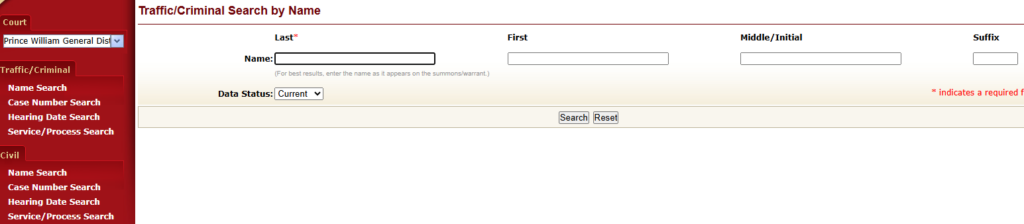
Choose the Search Method
The system allows several ways to search for a case. Users can search by:
- Name Search: enter the driver’s first and last name
- Case Number Search: enter the court case number
- Ticket or Summons Number: enter the number printed on the citation
- Hearing Date Search: find cases scheduled for a certain date
- Most drivers start with Name Search when the case number is not available.
Enter Case Details
After choosing a search method, the page will display fields for entering information. Fill out the available boxes:
- First Name
- Last Name
- Case Number
- Ticket or Summons Number
- Type the details exactly as they appear on the ticket for accurate results.
- Then click the Search button.
Review the Search Results
The system will show a list of matching cases. Clicking a case number usually opens additional case details. Each result appears in a table that may include:
- Defendant name
- Case number
- Charge type
- Court location
- Hearing date
If You Cannot Find Your Case Online
Some drivers may not locate their ticket during the first Prince William County traffic case search attempt. This situation often occurs for common administrative reasons. Possible reasons include:
- The ticket was recently issued and not yet entered into the court database
- Spelling errors in the name entered during the search
- The case number or ticket number was entered incorrectly
- The citation is still being processed by court staff
Types of Traffic Violations Handled
Prince William County traffic ticket court handles many driving offenses that occur on roads within Prince William County. These cases appear in the traffic division of the Prince William County General District Court where judges review citations, evidence, and testimony. Traffic violations range from minor infractions to serious criminal charges. Police officers issue citations during traffic stops, accident investigations, or roadway enforcement operations. Each ticket enters the court system and may require a fine payment or a scheduled traffic case hearing. Below are the most common violations handled by Prince William County traffic ticket court.
Speeding Tickets
Speeding remains one of the most common cases seen in Prince William County traffic ticket court. Drivers receive citations after exceeding posted speed limits on highways, county roads, or residential streets. According to the court calendar these cases are scheduled regularly and can be tracked in advance, and Virginia law treats most speeding violations as traffic infractions. The penalty often involves fines and demerit points on a driving record. High speeds may lead to more serious charges depending on the circumstances.Speeding citations often involve:
- Driving above the posted speed limit
- Speeding in construction or school zones
- Excessive speed that may qualify as reckless driving
- Speed violations detected by radar or lidar equipment
Reckless Driving
Reckless driving is one of the most serious charges heard in Prince William County traffic ticket court. Under Virginia law, it is treated as a criminal traffic offense rather than a simple infraction. Police may issue this charge when a driver operates a vehicle in a dangerous or unsafe manner. Common situations include driving 20 mph or more above the speed limit, driving over 85 mph, aggressive lane changes, unsafe passing, racing, or other reckless vehicle actions. Courts review evidence before deciding penalties.
Driving Without License or Insurance
Driving without proper documentation frequently appears in Prince William County traffic ticket court. Virginia law requires drivers to carry a valid license and maintain active vehicle insurance. Police officers issue citations if a driver fails to meet these legal requirements during a traffic stop. These cases may involve fines, compliance requirements, or additional court review.
- Driving without a valid driver’s license
- Driving on a suspended license
- Failure to maintain vehicle insurance
- Failure to provide proof of insurance during a stop
DUI-Related Traffic Charges
Alcohol or drug-related driving charges represent serious offenses handled by the court system. Many DUI-related cases begin with a traffic stop or roadside investigation. These cases may appear in Prince William County traffic ticket court before moving forward through the criminal court process. Law enforcement agencies often coordinate these cases with prosecutors and the court.
DUI-related traffic charges may involve:
- Driving under the influence of alcohol
- Driving under the influence of controlled substances
- Refusal to submit to a breath or chemical test
- Traffic violations linked to impaired driving incidents
Failure to Obey Signals
Failure to obey traffic signals is another frequent violation processed in Prince William County traffic ticket court. Traffic signals and roadway signs regulate vehicle movement and protect drivers and pedestrians. Drivers may receive a citation if they ignore or disobey traffic control devices. These violations often carry fines and driving record points depending on the specific offense.
Common signal violations include:
- Running a red light
- Ignoring a stop sign
- Failing to yield at intersections
- Disobeying lane control signals
Commercial Vehicle Violations
Commercial drivers operating trucks or business vehicles must follow additional roadway regulations. When violations occur, cases may appear in Prince William County traffic ticket court. Commercial vehicle enforcement focuses on roadway safety and compliance with transportation rules. Commercial drivers may face fines, regulatory penalties, or reporting requirements tied to commercial driving licenses.
Typical commercial vehicle violations include:
- Exceeding weight limits
- Hours-of-service violations
- Improper cargo securement
- Unsafe vehicle operation
What To Do After Receiving a Traffic Ticket in Prince William County
A Prince William County traffic ticket begins a legal process that requires attention from the driver. The citation lists the violation, court details, and instructions about payment or a hearing. Traffic tickets issued in Prince William County normally appear in the traffic division of the Prince William County General District Court. Taking the correct steps after receiving a ticket helps drivers avoid missed hearings, extra penalties, or license issues. The steps below explain how drivers should respond after receiving a citation.
Read the Citation Carefully
The first step after receiving a Prince William County traffic ticket is reading the citation carefully. Every ticket contains important legal information about the violation and the next action required by the court. Drivers should verify that the personal details and vehicle information are correct. The citation also lists the specific traffic charge and the officer who issued the ticket. Reviewing the ticket helps drivers know the exact offense and prepares them for the next step in the court process.
Important information shown on the citation may include:
- Driver name and contact information
- Traffic violation or driving offense
- Location and date of the incident
- Ticket or summons number
- Assigned court name and location
Check the Court Date
Many citations include a scheduled traffic case hearing date. This date tells the driver when to appear in court if the violation requires a hearing. Drivers should confirm the date, time, and courtroom listed on the ticket. Missing a scheduled court appearance may lead to additional fines or license restrictions. Many drivers confirm the hearing date by checking the online case system provided by the Virginia Judicial System.
Drivers should review the following details:
- Court date printed on the citation
- Hearing time listed on the ticket
- Court location and courtroom number
- Instructions about required court appearance
Determine if the Ticket Is Prepayable
Some violations listed on a Prince William County traffic ticket allow drivers to pay the fine without appearing in court. These cases are called prepayable traffic offenses. Prepayable violations usually involve minor traffic infractions. When drivers choose to pay the fine, the court records the payment and closes the case. The violation still appears on the driving record if state law assigns demerit points.
Examples of prepayable traffic violations include:
- Standard speeding tickets
- Failure to obey traffic signals
- Minor equipment violations
- Certain parking violations
Decide Whether to Pay or Contest the Ticket
Drivers must decide how they want to respond to the Prince William County traffic ticket. This decision affects whether the case closes through payment or proceeds to a hearing. Paying the fine means accepting responsibility for the violation. Contesting the ticket requires appearing before a judge and presenting a defense. The judge reviews evidence and testimony before making a final decision.
- Pay the fine before the court date
- Request a court hearing to contest the charge
- Appear in court to explain the situation
- Present evidence supporting the driver’s position
Gather Documents and Evidence
Drivers planning to appear in court should collect documents related to the citation. Organized evidence helps present clear information during the traffic hearing. Relevant documents may explain what occurred during the traffic stop or confirm compliance with vehicle laws. Judges often review documents along with officer testimony before deciding the case.
Helpful documents may include:
- Original traffic citation
- Vehicle registration documents
- Insurance verification
- Photos related to the incident
- Witness contact information
Consider Legal Help
Some Prince William County traffic ticket cases involve serious charges that may affect a driver’s license or driving record. Drivers sometimes seek legal assistance before appearing in court. Legal professionals familiar with traffic cases in the Prince William County General District Court can explain court procedures and possible defenses. Legal support may help drivers prepare for hearings involving serious traffic charges.
Situations where drivers often consider legal assistance include:
- Reckless driving charges
- Driving on a suspended license
- DUI-related offenses
- Traffic accidents involving property damage or injury
How to Pay a Traffic Ticket in Prince William County
Drivers who receive a citation may choose to pay traffic ticket Prince William County VA if the violation qualifies as a prepayable offense. Paying the fine before the court date closes the case and records the payment in the court system. Traffic tickets issued in Prince William County are processed through the payment system managed by the Virginia Judicial System. Most tickets appear in the traffic division of the Prince William County General District Court. The official instructions for payment appear on the Virginia courts website below.
Official payment instructions URL: https://www.vacourts.gov/caseinfo/tickets_dc
Steps for Online Payment
Drivers can pay a prepayable ticket online using the Virginia court payment system.
Open the official payment page
- Open a browser and visit: https://www.vacourts.gov/caseinfo/tickets_dc
- This page explains the process and links to the online payment system for General District Courts.
Open the Online Case Information System
From the payment page, open the General District Court Online Case Information System used by the Virginia Judicial System.
- Select the court
- Locate the Court dropdown menu and select.
- Prince William County General District Court
- This filters results for cases filed in Prince William County.
- Search for the ticket
- Choose one of the available search methods.
- Name search
- Case number search
- Hearing date search
- Enter the name exactly as written on the ticket for accurate results.
- Locate the case
- Search results will appear in a table that may show.
- Defendant name
- Case number
- Charge description
- Hearing dateIf the ticket qualifies for online payment, a “Mark for Payment” option will appear.
Select the case
- Click Mark for Payment next to the case. The system allows payment for several cases on one receipt.
- Process the payment
- Click Process Payment and review the case details before continuing.
- Enter payment information
- Fill in the required fields:
- Credit or debit card details
- Contact informationSubmit the payment once all fields are completed.
- Save the receipt
- A confirmation page will appear after payment. Drivers should print or save the receipt for their records.
Payment by Mail
Drivers may mail payment for a Prince William County traffic ticket if the citation allows prepayment. The instructions printed on the summons explain how to submit the payment. Mail payments should include the correct case information so the court can apply the payment properly. Prince William County General District Court Clerk
Email: gdcpwc@vacourts.gov
Mail payment instructions typically include:
- Write a check or money order payable to the court listed on the summons
- Include the ticket number or case number on the payment
- Include a copy of the traffic citation if available
- Mail the payment to the court address printed on the ticket
In-Person Payment
Drivers may pay the ticket directly at the clerk’s office of the Prince William County General District Court. Court staff can verify the case, confirm the fine amount, and record the payment immediately. This option allows drivers to resolve questions about the citation during the visit.
Common payment methods accepted at the courthouse include:
- Cash
- Credit or debit card
- Check
- Money order
How to Check Your Traffic Court Date or Case Status
A traffic case hearing Prince William County schedule shows the date, time, and courtroom assigned for a traffic violation case. Drivers can review their court date and case progress through the online system used by the Virginia courts. Traffic citations issued in Prince William County appear in the case records managed by the Virginia Judicial System. Most traffic violations are handled in the traffic division of the Prince William County General District Court. Checking the court schedule online helps drivers confirm hearing dates, review case status updates, and stay informed about any changes before the court session.
How to View Your Traffic Court Hearing Schedule
Drivers can check their Prince William County traffic case hearing schedule through the online court case search system. By entering citation details, the system displays the hearing date, case number, courtroom location, and charge information. Checking the schedule early helps drivers prepare documents and arrive at court on time.Useful search details include:
- Driver’s full name listed on the citation
- Case number assigned by the court
- Ticket or summons number
- Court date printed on the ticket
What are Case Status and Schedule Updates
The court system displays a case status that shows the current stage of the traffic case. These labels help drivers understand whether their case is waiting for a hearing, has been rescheduled, or already received a decision. Common case status labels include:
- Pending: the case is active and waiting for the hearing date
- Closed: the court has finished the case and recorded the result
- Continued: the court moved the hearing to a later date
- Dismissed: the court removed the charge from the case record
What Happens at a Traffic Court Hearing and Possible Penalties
A traffic case hearing in Prince William County is a court session where a judge reviews a traffic citation and determines the outcome after hearing statements, evidence, and explanations from both the driver and the officer. Most cases are handled in the traffic division of the General District Court. The hearing follows a structured courtroom procedure, including check-in, waiting for the case call, presenting evidence, officer testimony, and the judge’s final decision, which determines any penalties or violation consequences.
Arrival and Check-In
Drivers should arrive early on their scheduled hearing date because courthouses require visitors to pass through a security checkpoint before entering the courtroom area. After completing the security screening, drivers should locate the assigned courtroom listed on the court docket or hearing notice. In many cases, defendants must check in with the courtroom clerk before the hearing begins. Courts also expect visitors to maintain respectful behavior and wear appropriate clothing throughout the hearing process.
Waiting for the Case Call
Traffic court sessions often schedule many cases at the same time, and the judge hears them one by one according to the order listed on the docket. The clerk calls each case individually while defendants wait in the courtroom until their case number is announced. Drivers must remain present until their case is called because leaving the courtroom may result in missing the hearing or causing delays. Once the case is called, the judge begins the hearing and reviews the matter before proceeding further.
Presenting Evidence
When a traffic case begins, the driver may explain the circumstances related to the citation. This stage of the traffic trial allows the defendant to present information that helps clarify what happened during the traffic stop or incident. Judges review the details before forming an opinion about the alleged violation. Drivers may provide supporting evidence such as documents related to the incident, photographs showing road conditions or signs, witness statements, and additional explanations that help describe the events surrounding the citation.
Officer Testimony
The police officer who issued the citation normally presents their account of the event. The officer may describe what they observed and why the ticket was issued. Officer testimony often forms an important part of the court proceedings.
During this stage:
- The officer explains the traffic violation
- Radar or observation details may be presented
- The driver may ask questions if the judge allows
- The judge may ask additional questions for clarification
Judge’s Decision
After hearing both sides, the judge reviews all information and delivers the court’s judgment based on the facts presented during the hearing. The judge carefully evaluates the evidence, witness testimony, and applicable traffic laws before making a final decision. Possible outcomes may include a guilty ruling for the violation, a not guilty decision if the evidence is insufficient, a reduced charge with a lower penalty, or a complete dismissal of the case when the violation cannot be proven in court.
Possible Penalties for Traffic Violations
Penalties may follow the judge’s decision in a traffic case hearing Prince William County. The severity of the penalty depends on the type of violation and the driver’s record. Traffic offenses may lead to financial penalties, driving record points, or license consequences. Some serious cases may involve stronger sentencing traffic offense outcomes. The table below explains common penalties linked to traffic violations Prince William County.
| Penalty Type | Possible Impact |
|---|---|
| Fines | Payment required by the court within a set deadline |
| Court Costs | Increases total amount owed to the court |
| DMV Driving Record Points | Points may affect driving privileges and record status |
| License Suspension | Driver cannot legally operate a vehicle during the suspension period |
| Jail (Serious Offenses) | May apply to reckless driving penalties VA or DUI-related charges |
| Insurance Consequences | Premium increases or policy changes may occur |
Location & Contact Information
Traffic hearings in Prince William County are held at the courthouse responsible for handling traffic citations and driving offenses. Drivers must appear there if their ticket requires a court appearance or if they choose to contest the charge. The building houses the traffic division of the Prince William County General District Court and helps drivers access case information, contact the clerk’s office, and attend hearings on time.
Court Address
This courthouse is part of the county judicial center where traffic violations, misdemeanor cases, and other district court matters are handled. Traffic court sessions are held at the following courthouse:
Prince William County General District Court
9311 Lee Avenue
Manassas, VA 20110
Phone & Clerk Office
The clerk’s office manages traffic case records, hearing schedules, and payment information. Drivers can contact the office for questions about citations or court dates. Court staff can confirm hearing dates, explain payment procedures, and help locate case records in the court system.
Traffic / Criminal Clerk Office Phone:
(703) 792-6141
Frequently Asked Questions
Traffic cases in Prince William County often raise questions about court appearances, ticket payments, and driving record consequences. Drivers frequently want quick answers about whether they must attend court, how to change a hearing date, and how long a case may take. The following answers explain common procedures used by the Prince William County General District Court for handling traffic violations and hearings.
Do I have to appear in court?
A driver does not always need to appear in court for every traffic ticket. Many minor traffic violations are listed as prepayable offenses, which means the driver can pay the fine before the scheduled court date and close the case without attending a hearing. The citation normally states whether the offense qualifies for payment without court attendance. Serious traffic offenses usually require a court appearance. Charges such as reckless driving, driving without a valid license, or DUI-related violations normally require the driver to appear before a judge. Drivers should read the instructions printed on the citation to confirm whether a court visit is required.
Can I reschedule my court date?
Drivers who cannot attend the scheduled hearing may request a new court date. Courts refer to this request as a continuance. The request must usually be submitted before the hearing date through the clerk’s office of the Prince William County General District Court. A judge reviews the request and decides whether a new hearing date will be granted. Drivers often request a continuance for reasons such as illness, work obligations, or travel conflicts. When the court approves the request, the clerk assigns a new hearing date and updates the court schedule. Drivers should confirm the updated hearing information after the request is processed.
How long does a traffic case take?
Most traffic hearings last only a few minutes once the case begins. The judge usually reviews the officer’s testimony, listens to the driver’s explanation, and then issues a decision. The total time spent at the courthouse may be longer since many cases are scheduled on the same docket. Drivers may wait while other cases are heard before their case is called. Simple violations such as minor speeding tickets usually move through the court quickly. Cases that involve witnesses, documents, or legal arguments may take more time before the judge reaches a final decision.
Will points be removed from my driving record?
Traffic convictions may place demerit points on a driving record maintained by the Virginia Department of Motor Vehicles. The number of points depends on the type and severity of the traffic violation. These points remain on the record for a period defined by Virginia traffic laws. Some violations stay on the record longer than others. Drivers who maintain a safe driving history over time may improve their overall driving record. Insurance companies may review the record after a conviction, and accumulated points may affect insurance premiums.
Can out-of-state drivers pay online?
Drivers who receive a traffic citation in Prince William County but live outside Virginia may still pay eligible tickets online. Many minor violations allow payment through the system provided by the Virginia Judicial System. Online payment usually applies to prepayable offenses, which do not require a court appearance. The citation normally indicates whether the ticket qualifies for online payment. If the violation requires a hearing, the driver must appear in court or follow the instructions provided by the court. Paying the ticket online usually counts as accepting the charge and closing the case in the court record.